
If you are like most reasonably accomplished students (and some professionals), you have seven to eight key signatures that you are reasonably comfortable with and four to five that are murky. Developing key fluency will do wonders for your musical confidence and competence. It’s not as hard as you think! Simply devoting a few minutes a day to the task will lead to significant progress over the course of a year.
Start Simple. Pick a very simple phrase and play it on each starting note. For example: the first three notes of a major scale. From any note this sequence will be two consecutive whole steps. When this is easy, add the fourth note (a half step above the third). Eventually work up the entire scale, following the pattern of intervals: Whole-Whole-Half-Whole-Whole-Whole-Half.
Next, try transposing simple tunes like nursery rhymes by assigning scale degrees to the notes. For example, the first line of “Twinkle Twinkle Little Star” in any key is 1-1-5-5-6-6-5, 4-4- 3-3-2-2-1.
Start with the “hard keys” and work toward the “easier” ones. There really are no harder keys, just ones that we use less often.
From None to All. Here are a few tips to help you remember the “hard” key signatures:
• The key of C has no sharps or flats.
• The key of C# has all sharps (seven).
• The key of Cb has all flats (seven)
• The key of seven sharps (C#) is the same as five flats (Db). Five of one = seven of the other.
• The key of seven flats (Cb) is the same as five sharps (B). Seven of one = five of the other.
• The key of six sharps (F#) is the same as the key of six flats (Gb). Six of one = six of the other.
Now you can remember the keys of 5, 6 and 7 sharps or flats. All that’s left to learn are the keys of 1, 2, 3 and 4 sharps and flats. There are only 12 distinct keys (15 if you count enharmonic keys such as Db major and C# major). Developing the ability to play equally well in all keys is not an overnight job but neither is it a lifetime pursuit.
About the Author
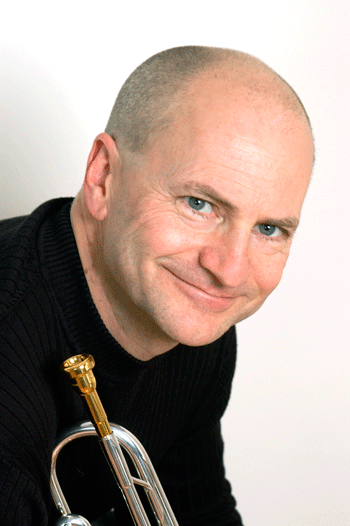
Chase Sanborn is a jazz trumpet player based in Canada and the author of “Brass Tactics,” “Jazz Tactics,” “Tuning Tactics” and “Music Business Tactics.” He teaches at the University of Toronto and is a Yamaha Artist. Chase has just released his fifth CD, titled “Double Double.” Visit him on the web at www.chasesanborn.com.
